Flower growing guide
Annabelle hydrangea
Hydrangea arborescens 'Annabelle' · Hydrangeaceae
Sun
Part shade
Season
Summer bloom
Maturity
2 to 3 years to full size
Water
High
Soil pH
5.5 to 7.0
Spacing
4 to 6 ft
By Dandre Noah
Planting annabelle hydrangea
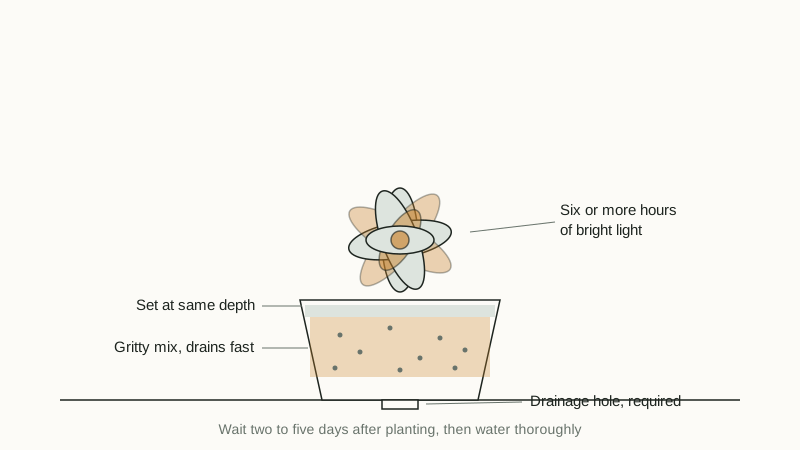
Plant container shrubs in spring or fall at the same depth they grew in the pot, and water them in deeply. Annabelle is the most cold-tolerant hydrangea most gardeners will meet, hardy in zones 3 to 9, and it is also the most forgiving about pruning because it blooms entirely on new wood. Placement depends on latitude: in zones 7 to 9 give it morning sun and afternoon shade, while in zones 3 to 6 it handles full sun all day as long as the soil stays evenly moist. It wants a moisture-retentive soil improved with compost; an established clump wilts dramatically on dry afternoons even when the ground is not truly dry, so permanent droughty spots in full sun are the wrong home for it.
Planting details
- Spacing: 4 to 6 feet; a mature shrub runs 3 to 5 feet tall and wide
- Blooms on new wood, so late-winter pruning never sacrifices flowers
- Flower heads reach 8 to 12 inches across on a single season's growth
- Set the crown at the same depth it grew in the container
- Annabelle was found wild near Anna, Illinois, and introduced in the early 1960s
Growing requirements
Partial shade is the safe default: three to six hours of morning sun with protection from hot afternoon light. Farther north it takes full sun if you keep it watered, since wilting heads droop faster than the plant takes damage. The soil should be moist but drained and rich in organic matter, with a neutral to slightly acidic pH. Flower color is fixed white; the pH-driven blue-to-pink trick works on bigleaf hydrangea, not this species. Water deeply about once a week and more in heat, and feed lightly in spring, because heavy nitrogen pushes soft stems that collapse under the huge flower heads.
Harvesting and care
The annual decision is how hard to cut it. Prune to about 12 inches, or even to the ground, in late winter or early spring and you get the biggest heads of the year on new shoots, though fewer and floppier ones. Leave 2 feet of framework and you get more, smaller blooms on sturdier stems. Skip pruning entirely and the shrub still blooms but grows twiggy and weak-stemmed. Deadhead through summer for a lighter second flush. The dried heads hold through winter if you leave them, which is the honest argument for waiting until spring to cut.
Common mistakes
- Planting in deep shade, which produces a tall, leaf-heavy shrub that barely blooms
- Never pruning it, which leaves a twiggy thicket of weak stems that sprawl under the flowers
- Expecting soil pH to change the flower color; Annabelle is white regardless
- Siting it in hot, dry full sun, where it wilts every afternoon and leaf edges scorch
- Heavy nitrogen feeding, which grows lush floppy stems that collapse after the first storm
- Pruning in early spring after growth starts and cutting off the season's developing heads
Companion plants
Annabelle belongs to the moisture garden, so pair it with plants that want the same damp, partly shaded footing: hosta and ferns fill the ground under it, and bee balm shares its appetite for moisture while covering the shrub's bare legs. Astilbe and heuchera match the light regime. Because the white heads read as a backdrop, it also works behind sunnier perennials at a bed's north edge, where it gets morning light and shades itself by noon. Do not crowd it against thirsty trees or full-sun dryland plants like lavender, which want the opposite soil.
Varieties worth growing
- Incrediball: the direct upgrade; stronger stems carry even larger heads without flopping
- Invincibelle Spirit and Mini Mauvette: pink-blooming arborescens types on sturdier frames
- 'Haas' Halo: lacecap bloom with fertile florets that actually feed pollinators
- 'Grandiflora': older cultivar with slightly smaller heads and the same floppy habit
Frequently asked questions
Why does my Annabelle hydrangea flop over?
The heads are simply too heavy for the year's new stems, especially after rain and after hard pruning to the ground. Leaving 1 to 2 feet of old wood as a framework, skipping heavy feeding, or switching to Incrediball all help.
When should I prune Annabelle hydrangea?
Late winter or early spring, before growth starts. It blooms on new wood, so you can cut it to about 12 inches or lower without losing the season's flowers.
Can I turn Annabelle hydrangea flowers blue or pink?
No. The pH color change only works on bigleaf hydrangea, Hydrangea macrophylla. Smooth hydrangea flowers stay white, aging to green as they dry.
Is Annabelle hydrangea safe for dogs and cats?
Hydrangeas contain cyanogenic compounds and are listed as a problem for dogs, cats, and horses. Keep pets from chewing the leaves and flower heads.