Houseplant growing guide
String of pearls
Curio rowleyanus · Asteraceae
Sun
Bright; some direct
Season
Year-round indoors
Maturity
2 to 3 years
Water
Low
Soil pH
6.0 to 7.0
Spacing
Container; trails 2 to 3 ft
By Dandre Noah
Planting string of pearls
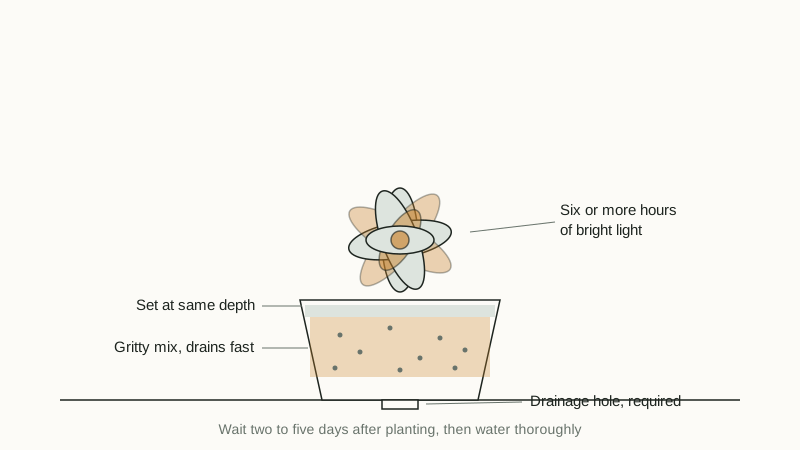
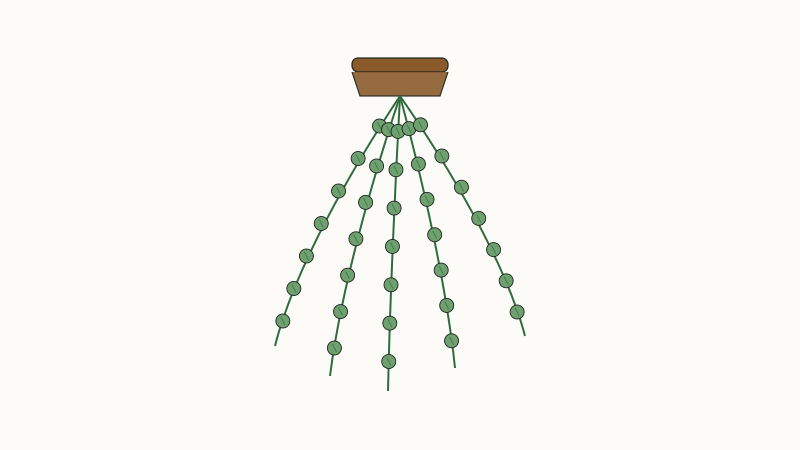
String of pearls grows in a shallow pot of gritty cactus and succulent mix, or houseplant soil cut half-and-half with perlite or pumice, always in a container with drainage holes. A hanging basket or a shelf edge lets the strands spill the way they want to. The fastest way to a full pot is to coil fresh strands on top of the mix and pin them down: NC State Extension notes the stems root wherever they touch the ground, so each pinned node becomes a new growing point. Outdoors it survives only in zones 9b to 11.
Planting details
- Shallow pot; strands root at the nodes where they touch the mix
- Gritty cactus mix or potting soil cut with half perlite or pumice
- Propagate with 3 to 5 inch stem cuttings laid on the surface
- Handle over the pot; the stems snap easily
- Outdoors year-round only in zones 9b to 11
Growing requirements
Give it bright light with a few hours of gentle direct sun, such as an east or bright south window; in dim light the strands stretch and the pearls space out into a sparse, gappy look. Water when the mix is nearly dry, but unlike thicker succulents, do not leave it bone dry for weeks at a time, because the thin stems and small leaves shrivel. NC State Extension recommends warm 70 to 80 F summers and a cooler 50 to 60 F rest in winter, with less water in the cool months. Each pearl carries a translucent stripe, an epidermal window that lets light reach the inside of the leaf.
Harvesting and care
Treat the strands as fragile: lift and move the pot rather than the plant, since stems snap at a touch. Mature plants naturally thin out and die back after a few years, so the maintenance plan is renewal, not revival; lay healthy strands on fresh mix and they root into a young pot. With enough light and a dryish summer it may surprise you with small white pompom flowers that smell faintly of cinnamon. Feed lightly at most a few times during the growing season.
Common mistakes
- Overwatering, which rots the stems right at the soil line
- Deep shade, which stretches the strands and widens the gaps between pearls
- Months of total drought, which shrivels the leaves into raisins
- Heavy, moisture-holding potting soil instead of a gritty mix
- A deep pot that stays wet long after the surface looks dry
Companion plants
It shares the sunny, dry-rhythm shelf with jade plant, aloe, and echeveria, which take the same bright light and sparse watering. Keep it far from moisture lovers like ferns and prayer plants. The leaves and sap are mildly toxic to people and pets and can irritate skin, so hang it out of reach and wear gloves if you handle many cuttings.
Varieties worth growing
- Variegated string of pearls: beads striped green and cream; slightly slower and fussier
- String of bananas (Curio radicans): cousin with curved banana-shaped leaves, easier and faster
- String of tears (Curio herreianus): teardrop leaves, sometimes sold as string of watermelons
Frequently asked questions
Why are the pearls shriveling?
Both too much and too little water cause it. Check the roots: black mushy stems mean rot from overwatering, while dry threads mean it needs a drink.
Is string of pearls toxic to pets?
Yes. The leaves and sap are mildly toxic to cats, dogs, and people, and the sap can irritate skin, so hang it out of reach.
Why is it bald on top but long below?
Light is reaching the trailing tips but not the crown. Give the top of the pot brighter overhead light, or coil and pin strands on the surface to fill it back in.
How do I propagate string of pearls?
Lay 3 to 5 inch cuttings on moist gritty mix and pin them so a few nodes touch the surface. Roots form at the nodes in a couple of weeks.