Houseplant growing guide
African violet
Streptocarpus ionanthus · Gesneriaceae
Sun
Bright indirect
Season
Year-round indoors
Maturity
2 to 5 years
Water
Moderate; from below
Soil pH
6.0 to 6.5
Spacing
Container; 6 to 9 in
By Dandre Noah
Planting african violet
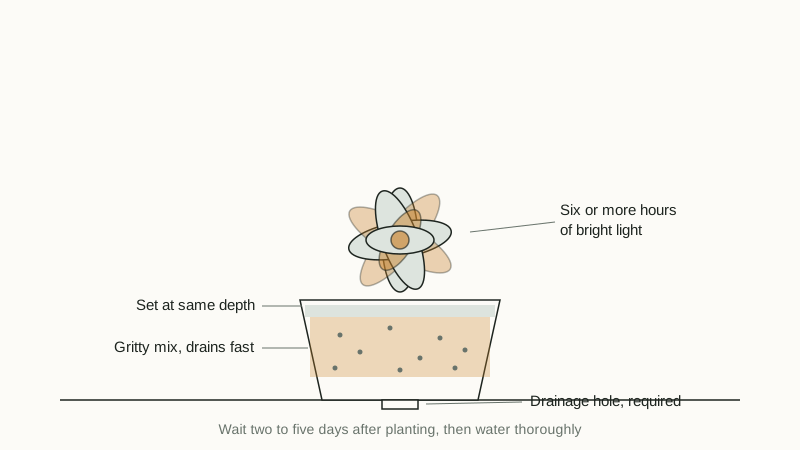
African violet wants a light, fluffy mix that drains fast, the bagged African violet blend of peat or coir with vermiculite and perlite, in a small pot with drainage holes. Set the crown just above the mix line and press gently; a buried crown rots. Small pots are not stinginess: the plant blooms best slightly rootbound, and a plant in too big a pot sits wet and sulks. Wick and self-watering pots suit it well since the plant prefers water from below.
Planting details
- Keep the crown above the soil line; burying it invites rot
- Use a light African violet mix, not dense potting soil
- Small pots: it blooms best slightly rootbound
- Propagate by leaf cutting: a leaf with 1.5 inches of stem in moist mix
- Non-toxic to cats and dogs
Growing requirements
Bright filtered light is the engine of bloom: a north or east window, or about a foot under a small grow light run 12 to 14 hours, gives flowers nearly year-round. Keep the mix evenly moist with room-temperature water, watering from the bottom or carefully at the soil line, because cold water splashed on the fuzzy leaves leaves pale rings and spots. Steady temperatures of 60 to 80 F suit it, and NC State Extension warns that nights below 60 F stunt the plant for weeks after. It likes humidity but hates wet leaves, so a pebble tray beats misting.
Harvesting and care
Pinch spent flower stalks at the base and peel off the outer ring of faded leaves to keep the rosette symmetrical; new leaves always emerge from the center. Feed weakly and regularly, a quarter-strength African violet fertilizer every few waterings or monthly, since steady fertility is what keeps the rebloom coming. Scrape the white salt crust off the pot rim when it builds. A healthy plant renews easily: one leaf with an inch and a half of stem pushed into moist mix produces a cluster of babies in a couple of months.
Common mistakes
- Overwatering, the number one killer, especially in dense soil or big pots
- Cold water on the leaves, which marks them with pale rings
- A buried crown, which rots at the soil line
- Too little light, the usual reason a healthy plant refuses to bloom
- Letting the plant go dry then soaking it, which stresses the fine roots
Companion plants
It is one of the pet-safe flowering houseplants, so it can share a bright shelf with prayer plants and spider plants where pothos could not go. Its gesneriad cousin, the lipstick plant, likes the same warm humid indirect light. Keep it off cold winter glass and out of direct sun, which bleaches the leaves rather than helping them.
Varieties worth growing
- Standard cultivars: 8 to 12 inches across; thousands of named varieties in every color
- Miniatures and semi-miniatures: under 8 inches, for small pots and terrariums
- Trailing types: multi-crowned plants that spread over the pot edge
- Lyon's Lavender Magic: frilled white and lavender blooms on a standard plant
- Persian Prince: miniature with dark purple semi-double flowers
Frequently asked questions
Why won't my African violet bloom?
Light is the usual answer, followed by fertilizer. It blooms nearly year-round only in bright filtered light with regular weak feeding; a dim corner keeps it alive but flowerless.
Is African violet safe for pets?
Yes, it is listed as non-toxic to cats and dogs, one of the few flowering houseplants that is.
Why are there pale rings and spots on the leaves?
Cold water touching the fuzzy foliage. Water from the bottom or at the soil line with room-temperature water and the new growth comes in clean.
How do I water an African violet from the bottom?
Set the pot in a saucer of room-temperature water for about 30 minutes, let it wick what it needs, then pour off the rest. Never let it sit in water for hours.