What this planting calendar calculates
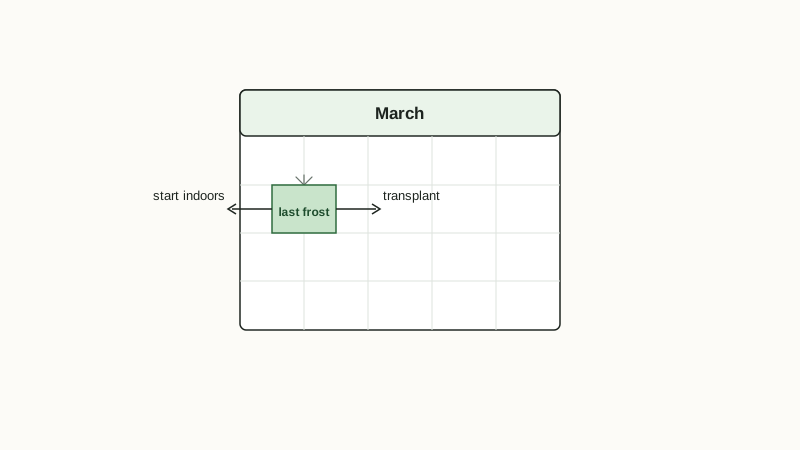
This calendar works forward and backward from the average last spring frost date you enter. Each selected crop has three possible planning windows: starting seeds indoors, transplanting seedlings, and sowing seed directly outside.
The dates are ranges rather than deadlines. A planting window leaves room for changing weather, soil conditions, and the speed of a particular variety. When a crop is not normally started with one of these methods, the calendar says so instead of producing an artificial date.
Find an average last frost date
Use a frost estimate for a nearby weather station or a local extension resource. A ZIP code, city, or hardiness zone alone does not provide an exact frost date. Elevation, slope, nearby water, and dense urban development can all shift the conditions in one garden.
An average date describes probability, not certainty. Frost can occur after the average in some years. Check the short-range forecast before transplanting tender crops, even when the calendar window has begun.
How the calendar works
Each crop is assigned a typical number of weeks before or after the frost date. For example, a crop that is commonly started indoors six to eight weeks before frost receives a window that begins eight weeks before the selected date and ends six weeks before it.
The same approach is used for transplanting and direct sowing. Cool-season crops may have outdoor windows before the last frost. Warm-season crops generally appear after it. These generalized ranges are planning defaults, not cultivar-specific instructions.
Read the three dates correctly
Start indoors
This is the useful window for sowing seed in trays or pots under protected conditions. It is not a germination date. Seeds started near the beginning of the window will usually be larger at transplant time than seeds started near the end.
Transplant
This is the estimated window for moving established seedlings into the garden. Harden seedlings off gradually before planting. Weather, soil temperature, and seedling size still matter on the day you transplant.
Direct sow
This is the estimated window for putting seed directly into prepared garden soil. Soil that is waterlogged, crusted, or unusually cold can delay a sowing even when the calendar date looks suitable.
Worked example
Suppose the average last frost date is April 15. A tomato timing of five to seven weeks before frost creates an indoor sowing window from late February to mid-March. If the transplant range is one to two weeks after frost, the outdoor window is April 22 to April 29.
A lettuce schedule behaves differently. Lettuce tolerates cool conditions, so indoor sowing, direct sowing, and transplanting can all begin before the last frost. This is why one frost date can produce very different schedules for two crops.
Use the calendar as a sequence
Start with the earliest indoor sowing task, then prepare containers, labels, and growing space before that window opens. Review the calendar weekly rather than trying to complete every crop on one day.
For crops with a broad direct-sowing window, consider several smaller sowings. This can spread germination risk and harvest timing. The tool does not calculate succession intervals, so record repeat sowings separately.
Important limitations
The calendar does not use live weather, soil temperature, elevation, or cultivar data. It also does not know whether a seed packet recommends a different schedule. Treat its dates as a first plan.
Seed packets should take priority when they give instructions for a named variety. Local extension guidance is especially useful in climates where summer heat, mild winters, or a short frost-free season changes the usual spring pattern.
Common planning mistakes
Treating the average frost date as a guarantee
An average is not the final frost in every year. Keep frost protection available and check the forecast before moving tender plants outside.
Starting every crop indoors
Some crops are better direct sown, while fast-growing seedlings can become root-bound if started too early. The calendar marks methods that are not usually recommended.
Ignoring the seedling stage
The calculated date does not guarantee that a seedling is ready. Healthy roots, suitable size, hardening off, and outdoor conditions all affect the final transplant decision.
Using zone as a planting date
A hardiness zone describes typical winter minimum temperature. It is useful for perennial survival, but it does not replace local spring frost information.
When this calendar may not be the right tool
Use the focused seed starting calculator when you only need one indoor sowing date. A fall garden needs a schedule based on first fall frost, maturity time, and heat during establishment. Tropical and frost-free climates also need a regional calendar rather than a spring frost countdown.
Frequently asked questions
Where does the last frost date come from? With a ZIP code set, the calendar uses the median last spring freeze from the nearest NOAA station. You can also enter a date yourself if you prefer a different probability level.
What is the difference between the three dates? Start indoors is when seeds go into trays, transplant is when seedlings move outside, and direct sow is when seeds go straight into the ground. Not every crop uses all three.
The calendar says sow, but my soil is still cold. Now what? The calendar is built from frost probabilities, not soil temperature. Wait until the soil can be worked and check the forecast. A week late beats seeds rotting in cold, wet ground.