Vegetable growing guide
Carrots
Daucus carota subsp. sativus · Apiaceae
Sun
Full sun
Season
Cool
Maturity
60 to 80 days
Water
Moderate
Soil pH
6.0 to 6.8
Spacing
2 to 3 in
By Dandre Noah
Planting carrots
Carrots are sown directly, because the taproot does not tolerate transplanting. Sow as soon as the soil can be worked in spring, 2 to 4 weeks before the last frost, in soil that has been loosened at least a foot deep and cleared of stones and fresh manure. Germination is slow, often 2 to 3 weeks, and the seedbed must stay evenly moist the whole time or the stand will be patchy. Sow a short row every 2 to 3 weeks through early summer for a continuous harvest, then again in late summer for a fall crop that sweetens after the first frosts.
Planting details
- Sow directly: 2 to 4 weeks before the last frost; do not transplant
- Thin seedlings to 2 to 3 inches once they stand a few inches tall
- Seed depth: about 1/4 inch; keep the surface moist until emergence
- Sow again every 2 to 3 weeks for succession
- Cover the seedbed with burlap or a board to hold moisture until sprouts appear
Growing requirements
Carrots want loose, deep, stone-free soil more than they want rich soil. Fresh manure or heavy fertilizer produces forked, hairy, or stunted roots, so work the bed well but do not overfeed. Soil pH 6.0 to 6.8 suits them. Keep moisture steady through the long germination window, then water deeply but less often once the tops are up. Light, sandy loam or well-worked raised beds give the straightest roots; heavy clay produces short, forked carrots unless it has been deeply amended.
Harvesting and care
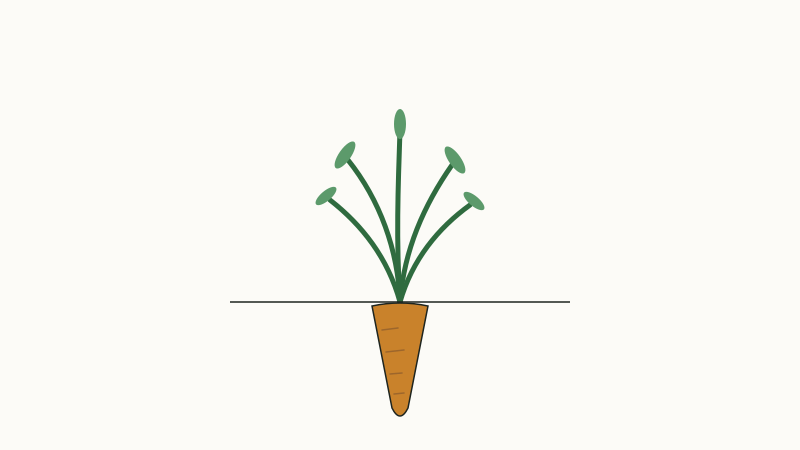
Pull carrots when the shoulders reach usable size, usually 1/2 to 1 inch across, by loosening the soil with a fork if the roots resist. Twist or cut off the tops within an inch of the crown before storage so the greens do not keep drawing moisture out of the root. In mild climates, carrots can stay in the ground under a thick mulch and be dug as needed all winter. For storage, pack them in damp sand or sawdust in a cool place.
Common mistakes
- Skipping thinning, which produces twisted, undersized roots
- Fresh manure or rich fertilizer, which causes forked and hairy roots
- Letting the seedbed dry during the slow germination window
- Sowing too deep or in crusted soil, which blocks emergence
- Pulling too early out of impatience, before the roots size up
Companion plants
Lettuce, radishes, and onions fit well near carrots because they occupy different depths and do not shade the low fronds. Radishes are often sown in the same row to mark where the slow carrots are coming up. Keep carrots away from dill, which can stunt them, and do not follow them with celery or parsnips in the same bed since they share diseases.
Varieties worth growing
- Nantes: sweet, cylindrical, and nearly coreless for fresh eating
- Danvers: tapered and dependable, good for heavier soil
- Chantenay: short and broad; the best choice for shallow or clay soil
- Rainbow mix: blended colors; same care, more visual interest
Frequently asked questions
Why did my carrots come out forked and twisted?
Stones, compacted soil, or fresh manure are the usual causes. The root tips hit an obstacle or a rich pocket and split, so deep, loose, moderately fertile soil is the fix.
How long do carrots take to germinate?
Usually 2 to 3 weeks, and the bed must stay moist the whole time. Covering the row with burlap or a board until sprouts show keeps the surface from crusting over.
Can I leave carrots in the ground over winter?
In mild climates, yes. Pull back mulch and dig them as needed; a few frosts actually improve the flavor by converting starch to sugar.