What does this raised bed calculator calculate?
This calculator does the arithmetic behind a simple four sided raised bed. It works out how many stacked courses of lumber it takes to reach your wall height, cuts the long sides and short ends for each course, packs those pieces into the stock board length you will buy, and reports the board count and the soil volume of the finished frame.
What you will need
Bed length and width
Measure the bed in feet. Beds wider than 4 feet are hard to reach into from both sides, which is why most plans cap the width there.
Wall height
The total height of the stacked walls in inches, not the height of a single board. Six to 12 inches covers most vegetable gardens, with taller beds useful where bending is difficult or the soil below is very poor.
Board size and stock length
Lumber is sold by nominal dimensions that are larger than the actual board. A 2 x 12 is really 1.5 inches thick and 11.25 inches tall. The calculator uses the actual board height when counting courses, then packs the cut pieces into the stock length you select: 8, 10, or 12 feet.
How the calculation works
The calculator divides the wall height by the actual board width and rounds up to get the number of courses. An 11 inch wall with 2 x 6 boards, which are really 5.5 inches tall, takes two courses.
Each course needs two long pieces and two short pieces, so an 8 by 4 foot bed needs 8 foot and 4 foot cuts. The calculator packs every piece into stock boards, fitting smaller offcuts around the long pieces to minimize waste, then rounds the total to whole boards.
Soil volume is the bed length times width times wall height in feet, reported in cubic feet and cubic yards.
Worked examples
An 8 by 4 foot bed with 2 x 12 boards
An 11 inch wall takes one course of 2 x 12 lumber. The bed needs two 8 foot sides and two 4 foot ends. Both 4 foot ends fit in one 8 foot board, so the whole frame takes three 8 foot boards and holds about 29 cubic feet of soil.
The same bed with 2 x 6 boards
Two 5.5 inch courses reach the same 11 inch wall. That means four 8 foot and four 4 foot pieces, which pack into six 8 foot boards.
A taller 4 by 4 foot bed
A 22 inch wall with 2 x 12 boards takes two courses. Eight 4 foot pieces fit neatly into four 8 foot boards, and the bed holds about 29 cubic feet of soil.
What the board count does not include
The cut list covers the four walls only. Plan separately for:
- Corner posts, usually 4 x 4 stock cut to the wall height plus a few inches to anchor in the ground
- Exterior rated screws, roughly three per board end
- Hardware cloth under the bed where burrowing pests are a problem
- A center support for the long sides of beds over 8 feet
Common mistakes
Measuring boards by the nominal dimension
Buying against the label size throws off the course count. Two nominal 6 inch boards do not make a 12 inch wall; they make an 11 inch one.
Forcing cuts that do not fit
No board side can be longer than the stock you buy, and cuts cannot be spliced. If a dimension exceeds the stock length, choose longer lumber or change the bed size.
Forgetting the soil budget
Lumber is often the smaller half of the cost. A filled 8 by 4 foot bed a foot tall needs more than a cubic yard of soil, so price the fill before building the frame.
When this calculator may not be the right choice
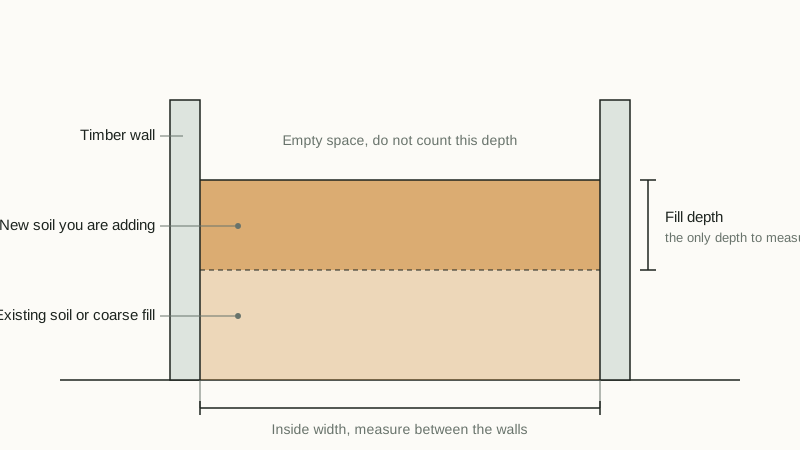
The packing logic assumes rectangular frames built from straight dimensional lumber. Beds with corner posts that swallow board ends, hexagonal or L shaped beds, and frames built from logs, stone, or metal panels need a different materials plan. The soil figure also assumes the frame is filled level to the top; beds filled over existing soil or a deep compost layer need less.
Frequently asked questions
Are nominal lumber sizes the real dimensions? No. A 2 by 6 board actually measures about 1.5 by 5.5 inches, and the calculator uses real dimensions when it plans the cuts. That gap between nominal and actual is the most common cause of a wall that comes out short.
What does the board count not include? Corner posts, stakes, hardware, and any liner are outside the cut list. The boards cover the walls; fasteners and anchors are a separate shopping item.
Is lumber or soil the bigger cost? Often soil. A tall 8 by 4 foot bed can take a cubic yard or more of fill, which can cost more than the frame. Check the soil volume line before committing to a tall design.