Flower growing guide
Jasmine
Trachelospermum jasminoides · Apocynaceae
Sun
Full sun to part shade
Season
Warm
Maturity
3 to 5 years
Water
Moderate
Soil pH
6.0 to 7.0
Spacing
3 to 5 ft
Planting jasmine
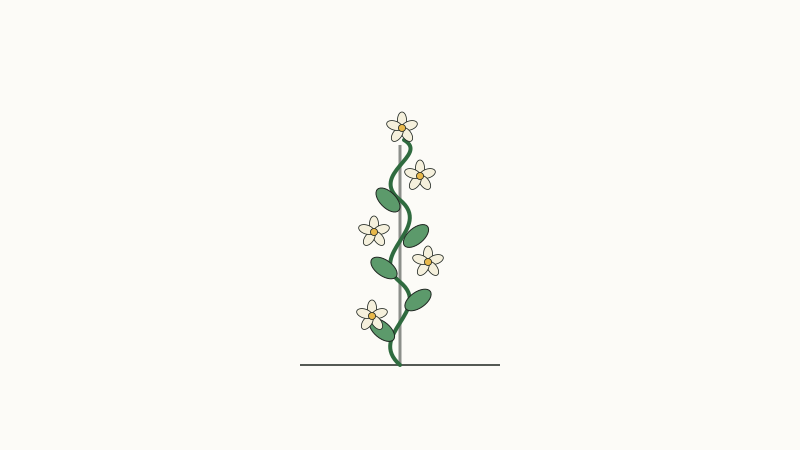
Plant in spring after the soil warms, in a sheltered sunny spot with a trellis, fence, or wires to climb; the stems twine, so they need something thin to wrap around rather than flat masonry. Star jasmine, the evergreen vine covered here, is hardy outdoors in zones 8 to 10 and flowers best in full sun on fertile, well-drained soil improved with leaf mold or compost. Colder gardens grow it in a patio container overwintered in a bright frost-free spot. When people say jasmine indoors, they usually mean Jasminum polyanthum, a different plant sold as a blooming houseplant in late winter.
Planting details
- Plant in spring into warm soil, in sun and shelter
- Spacing: 3 to 5 feet; a supported vine reaches up to 20 feet
- Needs a trellis or wires; twining stems cannot climb flat walls
- Evergreen outdoors in zones 8 to 10; container grown elsewhere
- Propagate by stem cuttings or layering
Growing requirements
Sun to part shade suits it, with the heaviest flowering in sun. It wants fertile, well-drained soil kept evenly moist while it establishes; once rooted it tolerates drought reasonably well. A spring feeding helps on thin soil, and yellowish leaves usually mean it wants fertilizer. Outdoors it is evergreen in zones 8 to 10, often bronzing in winter; north of that, treat it as a container plant. True jasmines differ: common jasmine is a hardy climber in mild climates, winter jasmine is a shrub blooming on bare stems, and Chinese jasmine is the tender pot plant.
Harvesting and care
Prune after the spring bloom to hold the vine to its space, and pinch tips on young plants to build lateral growth. Clean your tools after pruning, since the stems bleed a sticky sap. Star jasmine grown as a groundcover gets the upright shoots trimmed back to keep it low. Container plants come inside before frost into a bright cool room, where they coast until spring.
Common mistakes
- Planting against flat masonry; twining vines need a trellis, wires, or another plant to wrap
- Deep shade, which cuts the flower show to almost nothing
- Pruning before bloom, which removes the season's flowers
- Leaving a tender plant out past frost north of zone 8
- Assuming all jasmine is fragrant; winter jasmine has almost no scent
Companion plants
Star jasmine earns its keep where fragrance is the point: beside doorways, porch posts, and seating areas, or sharing a support with clematis for a second bloom season. As a groundcover it fills under roses and shrubs, and it doubles as a low informal hedge. It is reliably deer and rabbit resistant, which widens where it can go.
Varieties worth growing
- Star jasmine: the evergreen vine covered here; the most-planted jasmine in southern gardens
- Common jasmine: Jasminum officinale; a vigorous true jasmine climber for mild climates
- Chinese jasmine: J. polyanthum; the fragrant pink-budded houseplant sold in late winter
- Winter jasmine: J. nudiflorum; hardy shrub with yellow blooms on bare stems but no scent
Frequently asked questions
Is star jasmine a real jasmine?
No. Star or Confederate jasmine is Trachelospermum jasminoides in the dogbane family, named for its jasmine-like scent. True jasmines belong to Jasminum, though both grow similarly in the garden.
Why is my jasmine not blooming?
Usually too much shade, pruning at the wrong time, or a plant still establishing. Star jasmine flowers on the previous season's growth in spring, so hold any hard pruning until after bloom.
Can jasmine grow in a pot?
Yes, and it is the standard approach north of zone 8. Give it a small trellis, keep it watered, and move it to a bright frost-free spot for winter.
Is jasmine the same as Carolina jessamine?
No. Carolina jessamine is Gelsemium sempervirens, a different vine with yellow trumpet flowers, and it is far more toxic if eaten.