Houseplants
Why isn't my monstera splitting?
By Dandre Noah · Last reviewed 2026-10-22
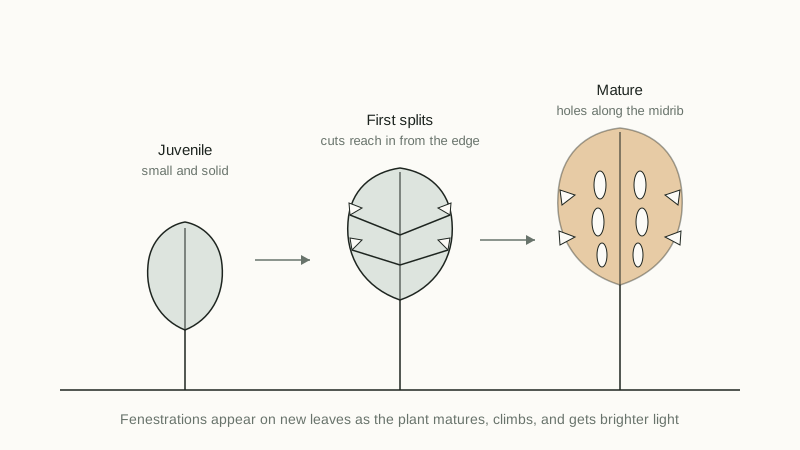
A monstera without splits is almost always a young plant, a plant in too little light, or a plant with nothing to climb. Fenestrations (the holes and slits in the leaves) appear only as the plant matures: give it bright indirect light, a moss pole or stake, and time, and the new leaves will come in split.
Nothing is wrong with the plant itself. Solid leaves are the juvenile form, and the splits are a feature of maturity, not health.
Check whether the plant is old enough
Monstera deliciosa starts life with small, solid, heart-shaped leaves. The University of Connecticut's monstera factsheet notes that fenestrations form at the midrib and radiate outward, increasing as leaf size progresses. In practice, a plant typically needs two to three years of growth before the first splits appear, and each new leaf comes in larger and more cut than the last.
If you bought a small plant recently, the answer is simply to wait. No care trick forces a juvenile leaf to fenestrate, and existing solid leaves never develop holes later. Only new growth changes.
Give it more light
Light is the lever most owners can pull. Monsteras are understory climbers from Mexican and Central American rainforest, and research on why the holes exist points at light: a 2013 study in The American Naturalist modeled fenestration as a way to spread leaf area and cope with the patchy sunflecks of the forest floor.
Indoors, a monstera in a dim corner stays in survival mode: small, solid, widely spaced leaves on long stems. Move it near a bright window where it gets strong indirect light for most of the day, or a few hours of gentle direct sun. The North Carolina Extension Gardener Plant Toolbox describes its preference as moderate brightness without sustained direct sun, in temperatures of 60 to 85 degrees F. If you are unsure how your spot stacks up, the sun calculator classifies a location by hours of usable light.
A grow light works too if the room is dark. Six to eight hours under a modest light makes a visible difference within a leaf or two.
Give it something to climb
In the wild, monstera is a climbing vine that can reach 70 feet up tree trunks. The UConn factsheet notes that once vines attach to a moss pole or stake, leaf size typically increases drastically, and bigger leaves are what fenestrate.
- Add a moss pole, coir pole, or rough-textured stake, and tie the main stems loosely to it.
- Press aerial roots toward the pole or into the pot. They are normal, not a problem to trim.
- A plant left to trail or hang downward stays in juvenile mode and keeps producing smaller, solid leaves.
Rule out a different plant
Two common look-alikes confuse the diagnosis. Monstera adansonii has narrow leaves with holes that stay inside the margin rather than deep splits from the edge. And "mini monstera" is Rhaphidophora tetrasperma, a different genus that splits at modest size but never forms the classic windowed leaf. If your plant's leaves have never looked quite like the pictures, the plant identification guide can confirm what you actually have.
Watering and feeding support faster maturity
Fenestration follows growth rate, so steady care speeds it along:
- Water thoroughly, then let the top quarter to third of the mix dry before watering again, per the NC State toolbox guidance.
- Feed monthly in spring and summer with a balanced houseplant fertilizer at half strength.
- Repot when roots circle the bottom; a root-bound plant stalls, and stalled plants do not produce bigger leaves.
If none of this applies, for example a mature plant in good light on a pole that suddenly puts out solid leaves, check for stress: recent repotting, root damage, or a drafty cold spot can cause a temporary reversion.
What to expect
Once conditions are right, watch the newest leaf. The sequence is predictable: larger solid leaves first, then shallow splits from the outer margin, then interior holes along the midrib. Each leaf takes weeks to unfurl, so judge progress in months, not days.
Frequently asked questions
Can I cut slits into a leaf to make it split? No. Fenestrations form while the leaf is still a tiny bud, through programmed cell death, long before it unfurls. Cutting an open leaf leaves a scar, not a split. Only new growth can fenestrate.
How long until the next leaf splits after I fix the light? Expect to wait for the next one or two leaves, which can mean one to three months in the growing season. The first leaf after a change is often only partly fenestrated; the splits deepen over the following leaves.
Does a variegated monstera split the same way? Yes, but slower. Variegated cultivars like 'Albo' carry less chlorophyll per leaf, so they grow more slowly and need brighter light to reach the same leaf size. NC State notes that variegated cultivars need more sunlight than the dark green forms.
Do the splits mean the plant is sick or damaged? No. Splits and holes are normal mature growth, not leaf damage or disease. Ragged brown-edged tears or chewed holes without a clean margin are damage; smooth-edged slits and oval windows that unfurl with the leaf are fenestration.
For similar large-leafed tropicals, the money plant and rubber plant profiles cover plants with comparable light needs. When your monstera is thriving, the next question is usually propagation, which is easiest by stem cutting taken just below a node.