Identification
What kind of plant is this? A field guide
By Dandre Noah · Last reviewed 2026-10-15
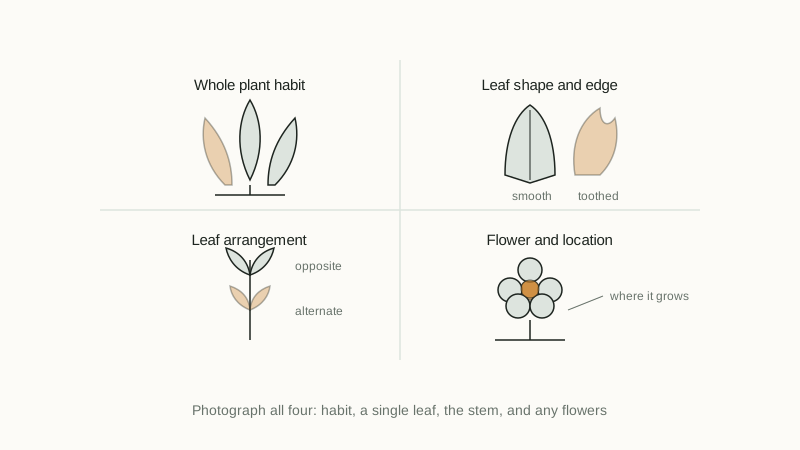
Start with four things: leaf shape, leaf arrangement on the stem, flowers or fruit, and where the plant is growing. Photograph each one, then run the photos through an app like PlantNet or iNaturalist and confirm the result against a botanical database. That combination gets you to a reliable ID faster than any single tool.
The reason for the extra steps is that apps are good but not perfect, and some look-alikes matter. Telling a zucchini seedling from a cucumber is trivial. Telling wild carrot from poison hemlock is not, and the difference decides whether a plant is safe to touch or eat.
Photograph the features that matter
Apps and human experts both work from the same evidence. A good set of photos takes about two minutes:
- The whole plant, showing its habit: upright, sprawling, climbing, clumping.
- A single leaf against your hand or a ruler for scale, front and back.
- Leaves on the stem, showing whether they sit opposite each other, alternate, or whorl around the stem.
- Flowers or fruit, plus a close-up of the flower's center.
- The location and setting: lawn, forest edge, roadside, pot, garden bed.
Skip blurry macro shots and artistic angles. Plain, in-focus photos in daylight outperform dramatic ones every time.
Read the plant before you search
A minute of observation narrows the answer even before you open an app:
- Leaf shape: simple or compound, smooth-edged, toothed, or lobed.
- Leaf arrangement: opposite pairs, alternating sides, or whorls. This one trait eliminates whole plant families.
- Stem: round or square, hairy or smooth, hollow or solid. A square stem and opposite leaves often means the mint family.
- Flowers: how many petals, what shape, clustered or solitary.
- Where it grows: a volunteer in a vegetable bed, a pond edge, and deep shade each point to very different candidate lists.
Use the apps, with honest expectations
Photo-based identification apps work well as a first pass. A 2023 study in People and Nature testing five free apps found that across all apps, 85 percent of images were correctly identified within the top five suggestions, and 69 percent were correct as the first suggestion. A separate PLOS One study of six apps found none exceeded about 88 percent accuracy, and all performed better on flowers than on leaves.
The practical takeaways:
- Try two different apps. Where they agree, the ID is probably right.
- Flower photos outperform leaf photos. If the plant is blooming, lead with that shot.
- The first suggestion is a hypothesis, not a verdict. Compare the suggested species against photos in a reference database before acting on it.
- Never eat or heavily handle a plant based on an app result alone. This matters most for mushrooms, berries, and anything in the carrot family.
University of Maryland Extension has been field-testing plant ID apps on common pasture and hayfield species, a useful look at how the tools perform on real plants rather than curated photos.
Confirm with free references
Once an app gives you a candidate name, confirm it:
- The Missouri Botanical Garden Plant Finder profiles more than 7,500 plants with photos and growing requirements, searchable by common or scientific name.
- The USDA PLANTS Database shows whether a species actually grows in your state and whether it is native, introduced, or listed as invasive.
- Your state university extension service publishes regional weed and plant guides. A web search for your state plus "extension plant identification" usually finds it, and many extension offices accept identification photos by email.
For houseplants and garden plants specifically, browsing the plant library can be faster than keying out a species: the profiles cover care requirements and show what a correctly identified plant should look like.
Context narrows the field fast
Before you photograph anything, answer two questions about the plant's setting.
Where is it? Geography eliminates most of the world's flora instantly. A volunteer in a Minnesota garden and the same-looking sprout in Arizona are different species. Apps use your location already; if you key the plant out manually, state-level floras and your extension's regional weed gallery keep the candidate list realistic.
What is it doing? A seedling that appeared in a vegetable bed in June is most likely a common weed or a self-sown crop. A vine climbing a fence narrows to a short family list. A succulent in a nursery pot is one of a handful of commercially grown genera: echeveria, sedum, crassula, haworthia. Matching the setting to a likely category is often faster than matching a leaf to a thousand leaf photos.
Look-alikes worth double-checking
Most misidentifications are harmless, but a few pairs deserve a second source before you act:
- Wild carrot (Queen Anne's lace) vs poison hemlock. Both are white-flowered members of the carrot family. Hemlock has smooth purple-blotched stems and no hairs; wild carrot has hairy stems and a carrot smell. Misidentification can be fatal.
- Strawberry vs mock strawberry. Similar leaves and red fruit, different edibility.
- Mint family members. Square stems and opposite leaves mark the family, but that family includes culinary mints and bitter ornamentals.
- Garlic and onion volunteers vs toxic ornamentals like star-of-Bethlehem. The onion smell test is the classic check: no onion smell, do not eat it.
Anything headed for the table should get a human confirmation from extension, full stop.
When to ask a human
Some cases deserve expert eyes: a plant that might be toxic to kids or pets, a suspected invasive on your property, a crop or weed you plan to spray, or anything you intend to eat. Your county extension office is the right contact, and it is free. Send the full photo set described above rather than a single leaf picture; you will get a faster, more confident answer.
Frequently asked questions
Can I identify a plant from a single leaf? Sometimes, but leaves are the weakest evidence. The same PLOS One study found every app performed better on flowers than leaves. Add the stem arrangement and the growing location and your odds improve sharply.
Why do two apps give different answers? Each app trains on a different photo library, so a species poorly represented in one library gets guessed as its nearest look-alike. When the answers disagree, compare both candidates against the Plant Finder or PLANTS entries rather than trusting whichever app answered first.
The app gave a name, but the plant does not match the photos. Now what? You may have a cultivar, a juvenile form, or a wrong ID. Check the scientific name rather than the common name, since common names are applied loosely, then look at multiple photos across sources. If it still does not match, run the ID again with a flower or fruit photo.
Once you know what the plant is, the next question is usually whether it will grow where you want it. The Can I grow this tool checks a plant against your light, space, and season so the identification turns into a decision.