Native plant growing guide
Arizona cypress
Hesperocyparis arizonica · Cupressaceae
Sun
Full sun
Season
Evergreen
Maturity
20 to 40 years
Water
Low once established
Soil pH
6.0 to 7.5
Spacing
7 to 15 ft
By Dandre Noah
Planting arizona cypress
Plant in spring or fall into full sun and soil that drains fast; those are the two conditions that decide whether this tree thrives or sulks. It is hardy in zones 7 to 11, native to the southwestern United States and Mexico, and it is still sold almost everywhere under its older botanical name, Cupressus arizonica. Space trees at least 7 feet apart for a screen and 15 feet or more where each will grow into its full 15 to 20 foot width. Set the root ball at grade, water it in, and keep the mulch ring clear of the trunk. Do not plant it under overhangs, in the path of irrigation, or in shade, because wet roots and thin light are what kill it.
Planting details
- Mature size: 40 to 60 feet tall and 15 to 20 feet wide; plan for the adult tree
- Screen spacing: at least 7 feet apart
- Full sun only; the foliage thins out in shade
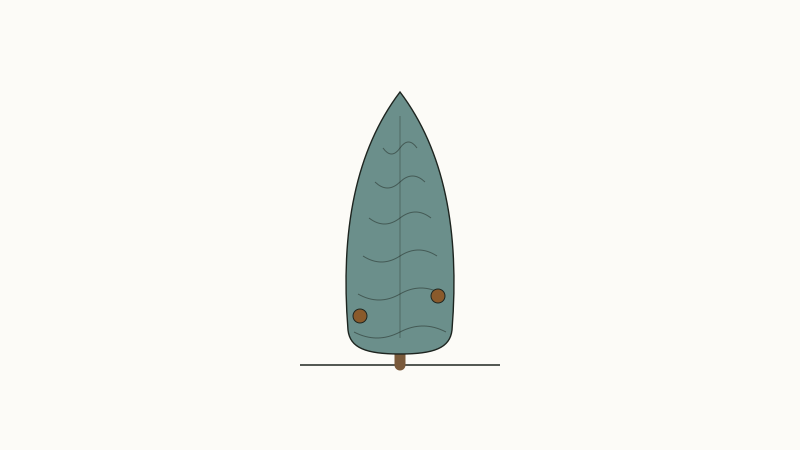
- Silvery-blue to teal scale-like foliage; dark red-brown cones about an inch across
- Currently classified as Hesperocyparis arizonica; still widely sold as Cupressus arizonica
Growing requirements
Full sun, always. In anything less the crown thins and the tree loses the dense silver-blue column people plant it for. The soil can be sandy, rocky, or lean, and slopes suit it well; what it cannot sit in is wet ground. Once established it asks for very little water, tolerates real summer heat, and handles moderate salt exposure, which is why it anchors so many dry southwestern screens and windbreaks. It grows steadily rather than fast, so it is not the tree for someone who wants a tall screen in three years. The problem worth watching is canker disease, which shows up as dying flagging branches, most often on trees stressed by humidity, poor drainage, or pruning wounds in wet weather.
Harvesting and care
Maintenance is minimal: deep water through the first two or three summers, then little to no irrigation once established. It needs no routine pruning to hold its conical shape, though cultivars grown for the Christmas tree trade get sheared annually to stay dense; homeowners can do the same lightly in late winter for a tighter screen. The aromatic, lacy foliage cuts well for holiday greenery. Cones stay closed on the branch until the stem dies, then open. Deer browse it less than most evergreens, a practical advantage in unfenced country. Remove dead or cankered wood well below the damage and clean tools between cuts.
Common mistakes
- Planting in shade, which thins the crown and ruins the silver column
- Wet or poorly drained soil and irrigation overspray, which rots roots and invites canker
- Spacing a screen tighter than 7 feet, then fighting the mature width forever
- Watering established trees on a lawn schedule
- Expecting fast growth; it builds height steadily, not quickly
- Shearing into old wood hard; conifers do not resprout from bare interior wood the way broadleaf shrubs do
Companion plants
Arizona cypress reads as a backdrop tree, so its companions are the drought-adapted understory that matches its irrigation budget: agave, Adam's needle, and lantana all take the same lean watering and full sun. Ornamental grasses and dryland perennials fill beneath it without asking for the sprinkler coverage that would threaten its roots. Keep lawns and irrigated beds at a distance, since the wet edge of a watered yard is exactly where canker and root problems start. Give neighbors room too; a tree headed for 20 feet wide should never have to be pruned back from a walkway.
Varieties worth growing
- 'Blue Ice': intense silvery-blue foliage; the standard Christmas tree cultivar
- 'Carolina Sapphire': electric blue needles; widely grown for cut greenery and Christmas trees
- 'Blue Pyramid': powder-blue column to about 25 feet with mahogany-red exfoliating bark
- 'Silver Smoke': feathery, smoky silver-gray foliage
- 'Sapphire Skies': another powder-blue selection for tight screens
Frequently asked questions
Is Arizona cypress really from Arizona?
Yes, plus New Mexico and Mexico. Its native range is the dry southwestern uplands, which is why drainage and sun matter so much and why humid climates are harder on it.
How fast does Arizona cypress grow?
Steadily, not quickly: think in terms of building a screen over several years rather than one or two. The tradeoff is a tree that asks almost nothing in water once established.
Will deer eat Arizona cypress?
Rarely. It is considered moderately deer resistant and holds up better than most evergreens in browse-prone areas.
Can Arizona cypress be used as a Christmas tree?
Yes. Cultivars like Blue Ice and Carolina Sapphire are commercially grown for it, and the aromatic silver-blue foliage is a standard in holiday greenery.