Houseplant growing guide
Baby's tears
Soleirolia soleirolii · Urticaceae
Sun
Bright indirect to part shade
Season
Year-round indoors
Maturity
Years
Water
High
Soil pH
5.0 to 6.5
Spacing
Container; spreads 3 to 6 ft outdoors
By Dandre Noah
Planting baby's tears
Baby's tears is a creeper that roots wherever a stem touches moist soil, which makes it one of the easiest houseplants to start: lay a handful of stems or a divided clump on damp mix and it knits itself in within weeks. Use a wide, shallow pot rather than a deep one, since the roots stay near the surface and the plant spreads sideways. Outdoors it is a perennial ground cover in zones 9 to 11, dying back and returning in zone 9; everywhere colder it is a houseplant or terrarium plant only. In warm-winter gardens it spreads fast enough to be weedy, and NC State Extension notes that even a small missed stem piece regrows, so plant it where it can be contained by edging or pavement.
Planting details
- Propagates by division or stem pieces laid on moist mix; roots in weeks
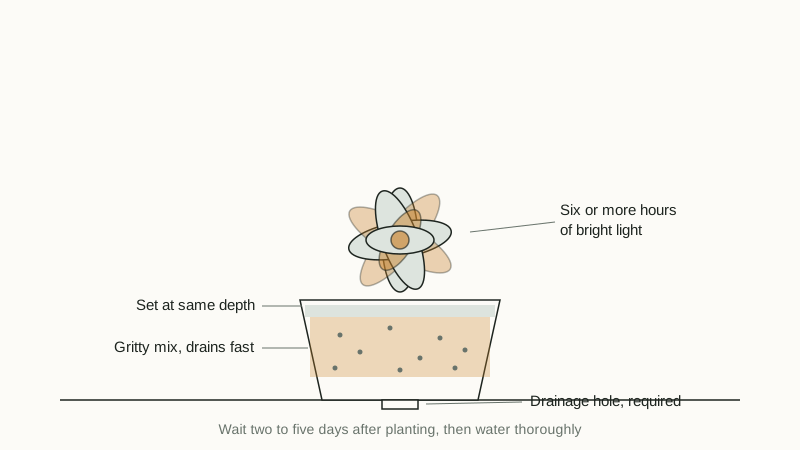
- Best in a wide, shallow pot with drainage; roots stay near the surface
- Outdoors as ground cover only in zones 9 to 11; dies back in zone 9 freezes
- Spreads up to about 6 feet outdoors but stays modest in a pot
- Often confused with Irish moss (Sagina subulata), a different plant entirely
Growing requirements
Bright, indirect light is the sweet spot; direct sun scorches the quarter-inch leaves, while deep shade thins the mat. NC State Extension describes ideal conditions as moderate temperatures, high humidity, and moist, fertile, well-drained soil on the acidic side. Humidity is the make-or-break factor indoors: dry winter air browns the edges even when the soil is wet, so terrariums, bathrooms, and pebble trays suit it far better than a dry shelf. Water before the mix surface fully dries; this plant has no drought tolerance and collapses fast, though it recovers quickly after a thorough soak.
Harvesting and care
Keep the mat trimmed to the pot with scissors when it starts lapping over the rim or climbing neighboring plants; every snipped piece can start a new pot. In a terrarium, expect it to eventually crowd out slower plants, and either thin it regularly or give it the jar to itself. Feed lightly during spring and summer with diluted liquid fertilizer every month or so. Watch for aphids, whiteflies, and scale, the few pests NC State Extension flags, and rinse them off or use insecticidal soap before they get established. Outdoors in mild climates, pull volunteers early, because the stems left behind root again.
Common mistakes
- Direct sun, which bleaches and scorches the tiny leaves in a single afternoon
- Letting the mix dry out completely, which collapses the whole mat at once
- Deep pots and dry air; it wants a wide shallow container and real humidity
- Planting it outdoors without an edge, then trying to remove it once it creeps
- Overfeeding, which pushes weak, leggy growth instead of a tight mat
Companion plants
Indoors it sits well beside other humidity lovers with the same light needs: nerve plant, prayer plant, and small ferns in a shared tray of damp pebbles. In a closed terrarium it eventually swallows companions, so pair it only with plants that can hold their own or accept the takeover. Outdoors in frost-free shade gardens it carpets under ferns and hostas and creeps over damp rock walls. It is rated non-toxic to cats, dogs, and horses, which makes it one of the safer trailing plants for homes with pets that chew.
Varieties worth growing
- Aurea: golden chartreuse leaves; the brightest of the group
- Golden Queen: yellowish leaf margins over green
- Silver Queen: silvery gray foliage that shows texture well in a pot
- Variegata: silvery green variegated leaves
Frequently asked questions
Is baby's tears toxic to pets?
No. NC State Extension lists it as non-toxic to cats, dogs, and horses, so it is a reasonable choice where pets nibble houseplants.
Is baby's tears the same plant as Irish moss?
No, though they look alike and share the name. Irish moss is Sagina subulata, a hardy outdoor ground cover. Baby's tears is Soleirolia soleirolii, a tender creeping perennial mostly grown indoors.
Why is my baby's tears turning brown?
Usually dry air or a dry spell between waterings. This plant has almost no drought tolerance, and low indoor humidity browns the leaf edges even in wet soil. Raise humidity and keep the mix evenly moist.
Can baby's tears live in a terrarium?
It thrives in terrariums because it wants exactly what a closed jar offers: humidity and indirect light. The catch is speed. It will eventually overrun smaller terrarium plants, so trim it or plant it alone.
Can baby's tears grow in low light?
It survives medium light, but the mat thins and stretches toward the window as the gaps between leaves lengthen. Bright indirect light keeps the foliage dense and the leaves quarter-inch small. A north window or a spot a few feet back from an east window keeps it compact without scorching, which is also the right exposure for the plants it pairs well with.