Houseplant growing guide
Ball cactus
Parodia magnifica · Cactaceae
Sun
Bright light to full sun
Season
Year-round indoors
Maturity
Years to bloom size
Water
Low
Soil pH
5.5 to 7.0
Spacing
Container; clumps to 12 in+
By Dandre Noah
Planting ball cactus
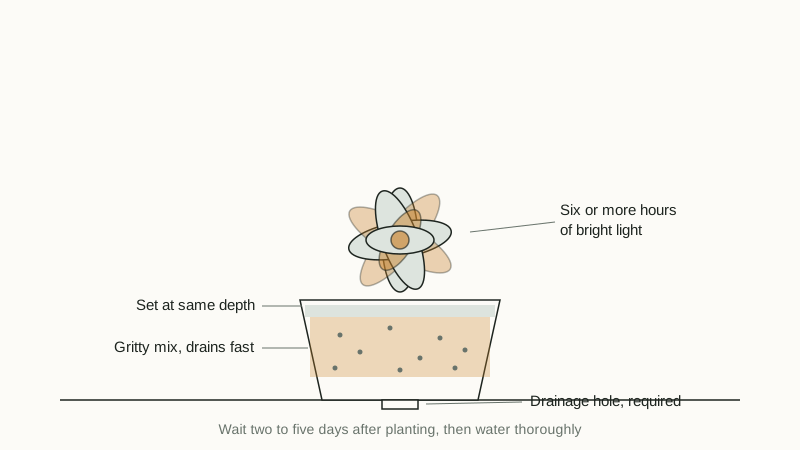
Ball cactus is a southern Brazilian species that almost every plant starts life as: a small nursery globe in a 3 or 4 inch pot. Plant it in a standard cactus and succulent mix in a container with a drainage hole, unglazed clay if you tend to overwater. Indoors it wants the brightest window you have, south or west facing; the Royal Horticultural Society recommends full sun or bright filtered light under cover. It is hardy only in zones 9 to 11, so outside the desert Southwest it summers on a patio and winters indoors. Repot in the warm season when roots fill the pot, going up just one size; an oversized pot holds wet mix the roots cannot reach and invites rot.
Planting details
- Standard cactus or succulent mix; a drainage hole is required
- Brightest available window; tolerates some filtered afternoon shade
- Repot in spring or summer, one pot size up, into dry mix
- Hardy outdoors only in zones 9 to 11; elsewhere bring it in before frost
- Propagated from seed or by separating offsets from a mature clump
Growing requirements
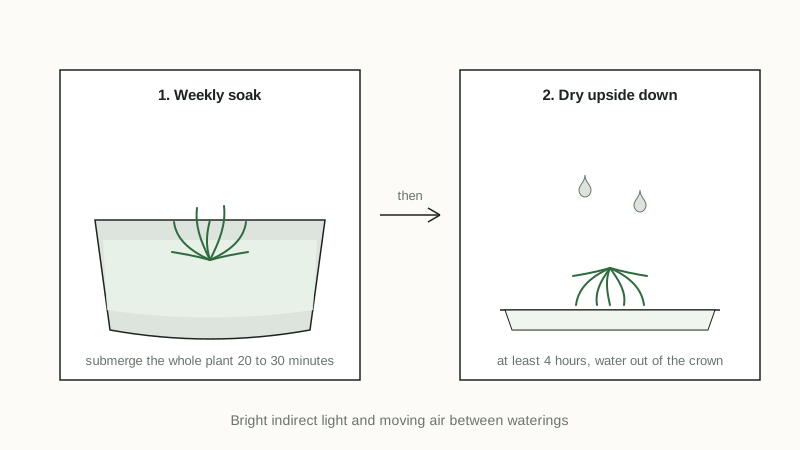
This is a cactus that wants a little more light and a little more even moisture than the desert stereotype. Bright light keeps the ribs tight and the golden spines dense; a dim shelf produces a stretched, pale ball that may never bloom. Water moderately during the growing season once the mix dries completely, then leave it alone until it dries again. NC State Extension advises letting the soil dry fully between waterings and never letting the pot stand in water. Feed with a low-nitrogen fertilizer every 6 to 8 weeks in spring and summer, as the RHS recommends. In winter, cool temperatures around 50 to 55 F and barely-moist mix are the trigger that sets summer buds.
Harvesting and care
The two jobs are a dry winter rest and occasional repotting. From late fall, cut watering back to a token amount and keep the plant cool; that rest period is what makes it flower, and without it you get a handsome ball that never blooms. The sulfur-yellow flowers open at the crown in summer and are worth the wait. Offsets appear at the base over the years and can be left to form a clustering mound or twisted off in spring to start new plants. Watch for mealybugs hiding between the ribs and aphids on flower buds, the only pests the RHS flags; cotton swabs and rubbing alcohol handle small outbreaks.
Common mistakes
- Watering on a schedule instead of waiting for the mix to dry completely
- Letting the pot sit in a saucer of water, which rots the roots fast
- Skipping the cool, dry winter rest and wondering why it never blooms
- A dim shelf, which stretches the ball and weakens the spines
- Wetting the plant body in hot sun, which can scorch or mark the skin
Companion plants
Group it with other small, sun-loving succulents that share the dry-then-soak rhythm: haworthia, small echeveria, aeonium, and jade plant all tolerate the same windowsill conditions. Avoid pairing it in a shared pot with moisture lovers or with thirsty cacti cousins that want more water; mixed containers fail when one plant needs a drink and the other needs drought. In frost-free climates it works outdoors in rock gardens and gravel beds alongside agave and aloe in fast-draining soil, kept where a stray hose cannot soak it daily.
Varieties worth growing
- Parodia lenninghausii: golden ball cactus; a taller columnar cousin over 12 inches
- Parodia scopa: silver ball cactus; white spines over a columnar stem
- Parodia haselbergii: scarlet ball; dense white spines and orange-red flowers
- Parodia ottonis: small clustered globes with yellow blooms and red hooked spines
Frequently asked questions
Why won't my ball cactus flower?
Usually because it misses winter rest or is still young. Ball cactus blooms best after a cool, near-dry winter around 50 to 55 F, then bright light and regular summer watering. Mature plants a few years old flower most reliably.
How big does a ball cactus get?
Slowly. A single stem reaches about 6 to 12 inches tall over years, and the plant gradually offsets into a clump up to a foot or more across. It is a windowsill plant for the long haul.
Can ball cactus live outside?
In zones 9 to 11, yes, in a rock garden or pot in fast-draining soil. Everywhere else it summers outside happily but must come indoors well before the first frost.
Is ball cactus the same as golden barrel cactus?
No. Golden barrel is Echinocactus grusonii, a much larger, sharper-spined plant. Ball cactus is Parodia magnifica, a smaller cluster-forming species with friendlier golden spines and reliable yellow flowers.
How often should I water a ball cactus?
Water deeply, then let the mix dry completely before watering again. During summer growth that can be every week or two in a small clay pot; in winter once a month or less. Wrinkled, deflated ribs mean thirst; softness at the base means rot, not thirst, so check the soil before reaching for the can.