Vegetable growing guide
Beets
Beta vulgaris · Amaranthaceae
Sun
Full sun
Season
Cool
Maturity
50 to 65 days
Water
Moderate
Soil pH
6.0 to 7.5
Spacing
3 to 4 in
By Dandre Noah
Planting beets
Beets are a fast cool-season crop that rewards successive sowings rather than one big planting. Sow seed directly 2 to 4 weeks before the last frost, then every 2 to 3 weeks through spring for a rolling harvest. In zones 8 and warmer, fall sowing in late summer is often more reliable than spring, since roots sweeten as temperatures drop. Each beet seed is actually a cluster of several seeds, so several seedlings always come up together and thinning is not optional.
Planting details
- Sow directly: 2 to 4 weeks before the last frost, then every 2 to 3 weeks
- Thin to 3 to 4 inches once seedlings stand a few inches tall
- Seed depth: about 1/2 inch
- Thinnings make good salad greens; do not waste them
- Soak seed a few hours before sowing in cool soil to speed germination
Growing requirements
Beets need full sun to light shade and loose, fertile soil free of stones and fresh manure, which produce hairy, forked roots. Keep moisture even, because dry spells make the roots woody and slow the leaf growth that feeds the bulb. Soil pH 6.0 to 7.5 suits them; beets tolerate a wider range than most vegetables but dislike waterlogged ground. Boron deficiency shows up as black, corky spots inside the root and is the main reason beets fail in sandy, low-organic soil.
Harvesting and care
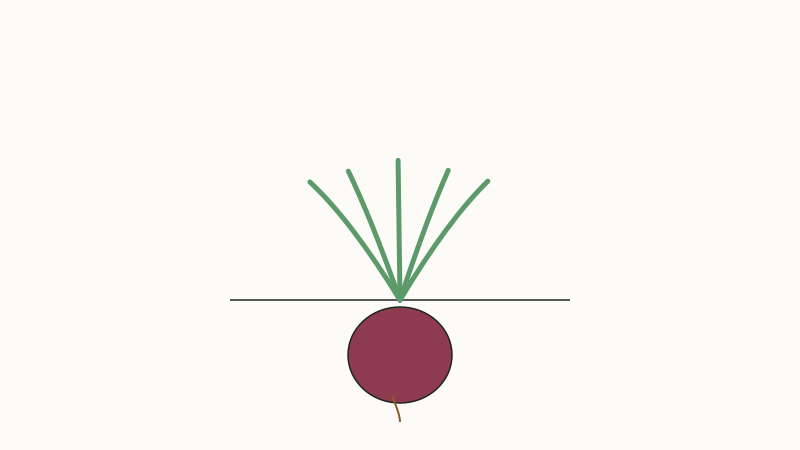
Pull roots when they reach 1.5 to 3 inches across for the sweetest, most tender texture; anything much larger turns woody. The greens are a second crop, best cooked like chard while the leaves are still young. For storage, twist off the tops an inch above the crown so they do not draw moisture out, then keep the roots cool and humid for months. In mild climates beets can stay in the ground under mulch and be pulled as needed through winter.
Common mistakes
- Skipping thinning, which leaves a mat of crowded roots that never size up
- Leaving roots in the ground too long, which turns them woody
- Inconsistent watering, which produces tough, ringed roots
- Fresh manure or heavy nitrogen, which causes forking
- Discarding the greens, which are a second edible crop
Companion plants
Beets grow well beside onions, lettuce, and bush beans because their round, shallow roots do not compete for the same root space. Their quick season lets them finish before summer crops need the room, so they work well as a gap filler between slower plantings. Keep them away from pole beans, which can stunt each other, and do not follow them with spinach or chard in the same spot since they share diseases.
Varieties worth growing
- Detroit Dark Red: the standard round red beet; dependable and good for storage
- Chioggia: candy-striped interior that stays mild
- Golden: yellow beets that do not bleed and taste less earthy
- Cylindra: long, uniform roots that slice evenly for pickling
Frequently asked questions
Why are my beets all leaves and no root?
Usually too much nitrogen or roots that were never thinned. Crowded seedlings put all their energy into tops, and rich fresh manure produces lush growth without the root.
Can I eat beet greens?
Yes, and they are often the better half of the plant. Cook them like chard or spinach while the leaves are still young and tender.
How do I store beets for winter?
Twist off the tops an inch above the crown, brush off soil, and keep the roots cold and humid in sand, sawdust, or a perforated bag. They hold for months.