Houseplant growing guide
Blood leaf plant
Iresine herbstii · Amaranthaceae
Sun
Bright, some direct sun
Season
Year-round indoors; zones 10 to 12 outside
Maturity
1 to 1.5 ft tall
Water
Even moisture
Soil pH
6.0 to 7.0
Spacing
12 to 18 in or pot
By Dandre Noah
Planting blood leaf plant
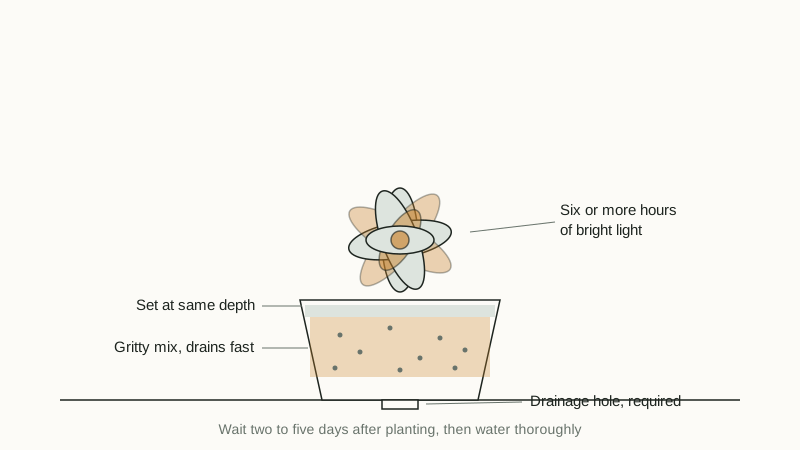
Bloodleaf roots so easily from stem cuttings that buying the plant is nearly optional: a 4 inch tip cutting in water or moist mix makes a new plant in a couple of weeks, which is how NC State Extension says it propagates. Pot it in ordinary rich potting mix, or plant rooted cuttings outside after frost as a bedding annual, where it fills the same red-foliage role as coleus. It is evergreen only in zones 10 to 12; in its native Peru it reaches 5 feet, but a potted plant rarely passes a foot and a half, and everywhere colder it winters on a bright sill.
Planting details
- Pot or bed spacing: 12 to 18 inches
- Grown for leaves: oval, notched, reddish-purple with pink or lighter red veins
- Pinch the growing tips to keep it bushy under 3 feet
- Non-toxic to cats, dogs, and horses per NC State Extension
- Strip off the insignificant flower buds so energy stays in the foliage
- Holds the Royal Horticultural Society's Award of Garden Merit
Growing requirements
Light keeps it red: outdoors NC State recommends full sun, and indoors that translates to the brightest window you have, since shade fades the leaves toward green. Soil should be moist but drained, watered evenly in growth and cut back in the cooler, darker months. It is a plant that forgives a missed watering less than most foliage houseplants; wilting is its loud and fast complaint. Normal room temperatures suit it; cold windowsills and drafts do not.
Harvesting and care
Pinch or shear the tips regularly and it stays dense; unpinched, it goes leggy and tired within a season, at which point cuttings restart it better than nursing the old plant. Take it outside in summer for stronger color and faster growth, then bring it in before nights turn cold. Watch for aphids and spider mites indoors and powdery mildew in still, damp air. Propagate a few cuttings each fall as insurance; this is a short-lived perennial that rewards fresh starts.
Common mistakes
- Dim light, which drains the red color that is the whole point
- Never pinching, which leaves a leggy plant within a year
- Letting it flower, which wastes energy on insignificant blooms
- Cold drafts and windowsills; it is injured well above freezing
- Keeping a woody, tired plant instead of rooting fresh cuttings
Companion plants
Indoors it groups naturally with other bright-light foliage plants: croton and nerve plant like the same sunny, evenly moist window, and the red leaves set off plain greens nearby. In summer beds it does the work of a coleus or caladium in sun where those two would rather have shade. Pet owners get a bonus: NC State lists it as non-toxic, rare for a plant this colorful.
Varieties worth growing
- Aureoreticulata: green leaves with yellow veins on red stems
- Brilliantissima: deep reddish-purple leaves, compact under a foot
Frequently asked questions
Is blood leaf plant safe for pets?
Yes. NC State Extension lists Iresine as non-toxic to cats, dogs, and horses, which makes it one of the safer ways to get red foliage indoors.
Why is my bloodleaf turning green?
Not enough light. The red pigments show best in strong light, so move it to the brightest window or give it a summer outside in sun.
Is it an annual or a perennial?
A tender perennial in zones 10 to 12, used as a summer annual or houseplant everywhere colder. It is short-lived even when happy, so keep cuttings going.
Is Iresine herbstii still the right name?
The plant is still sold under that name, but NC State now classifies it as Iresine diffusa f. herbstii, a form of Iresine diffusa. Either name gets you the same red-leaved plant.