Houseplants
How do you care for a spider plant?
By Dandre Noah · Last reviewed 2026-11-12
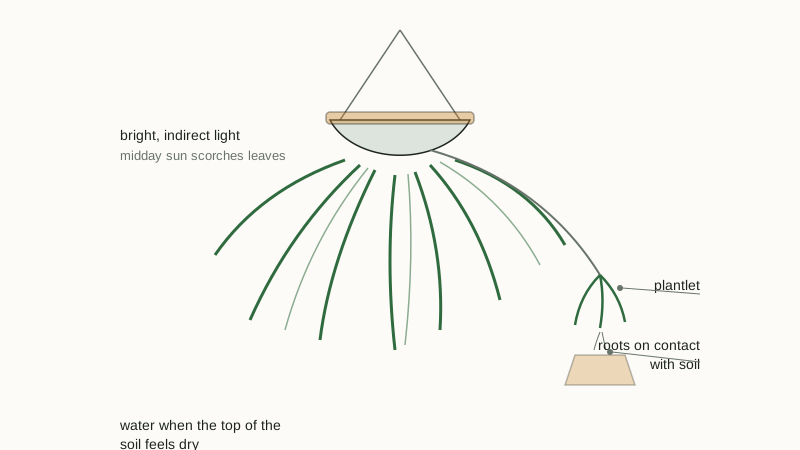
Give a spider plant bright, indirect light, a general-purpose potting mix, and a thorough watering whenever the top of the soil feels dry. It tolerates normal home temperatures, is non-toxic to cats and dogs, and produces baby plantlets you can root for free.
Spider plants (Chlorophytum comosum) have been popular houseplants for decades precisely because they forgive inconsistent care. The Clemson Home and Garden Information Center notes that in the home, diseases are rarely a problem; almost every issue comes down to water, salts, or light.
Light
Bright, indirect light is ideal. The plant tolerates some direct sun but midday sun scorches the leaves, and it survives lower light at the cost of slower growth and fewer plantlets. A few feet back from a bright window, or a bright bathroom, suits it well.
Water
Let the soil dry slightly between waterings, then soak it through. Clemson recommends checking the soil daily until you learn the plant's rhythm. Root rot follows from a mix that stays wet, so make sure the pot drains. Growth slows in winter; water less then.
Temperature and feeding
Daytime temperatures of 65 to 75 degrees Fahrenheit and nights of 50 to 55 degrees suit spider plants, and ordinary household temperatures are close enough. Keep the plant a few feet from a cold window in winter. Feed with a water-soluble houseplant fertilizer at the label rate during active growth, but go easy: heavily fed plants produce fewer plantlets and are more prone to tip burn.
Why the leaf tips turn brown
Brown tips are the question every spider plant owner eventually asks, and the causes are cumulative rather than dramatic:
- Soluble salts and fluoride or chlorine in tap water. Both Clemson and Wisconsin Horticulture flag this as a leading cause. Switching to distilled water or rainwater usually stops new tips from browning.
- Too much fertilizer. Feed at the label rate or less, and flush the pot with plain water occasionally to wash out accumulated salts.
- Low humidity and dry soil. Letting the plant go bone dry repeatedly shows up at the tips first.
Old brown tips stay brown; trim them off with clean scissors following the leaf's natural point. Judge progress by the new growth.
Repotting
Spider plants form thick, fleshy roots that can eventually crack a plastic pot, so repot or divide when the pot bulges or roots fill it. Any time of year works. A general-purpose potting mix is all it needs, and the potting mix calculator sizes the amount when you move up a pot.
Propagating the babies
Healthy plants send out long, wiry stems carrying miniature plantlets, mostly as the days shorten in fall. Each plantlet roots readily where it touches soil. Two ways to start a new plant:
- Pin a plantlet into a small pot of moist mix while it is still attached to the runner, then snip the stem once it roots.
- Or cut off a plantlet that already shows small roots and pot it directly into moist mix.
Leaving plantlets attached makes a fuller hanging basket; removing them gives you new plants.
Pets
The ASPCA lists spider plant as non-toxic to cats and dogs, which makes it one of the safer choices for a hanging basket in a home with animals.
What to do next
If you are building a collection of forgiving houseplants, our easiest plants to grow guide covers the other reliable starters, and pothos and cast iron plant tolerate similar conditions.