Houseplant growing guide
Anthurium veitchii
Anthurium veitchii · Araceae
Sun
Bright indirect
Season
Year-round indoors
Maturity
5 to 8 years
Water
Moderate
Soil pH
5.5 to 6.5
Spacing
2 to 3 ft
By Dandre Noah
Planting anthurium veitchii
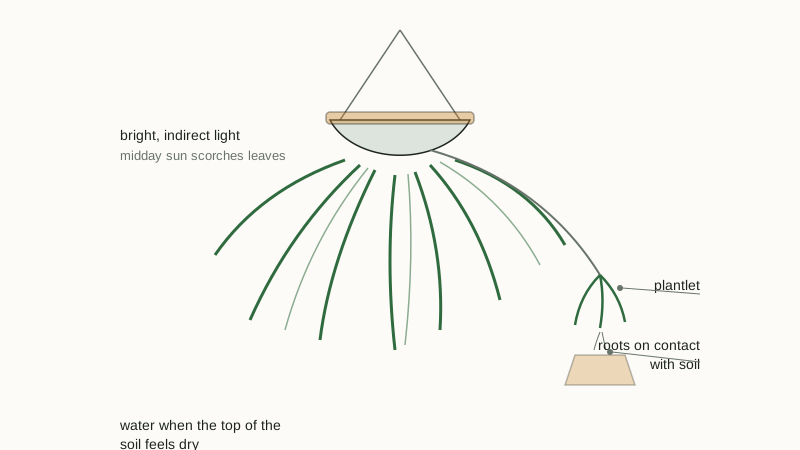
Veitchii is a Colombian epiphyte that grows hanging in trees, and the pot choice follows from that. The long leaves arch and then pendant, so a tall narrow pot, a hanging basket, or a mounted slab shows it better than a squat container. Use the loosest aroid mix in the house, mostly orchid bark with perlite and a little fiber, set the stem at the surface, and water in. Plants come in two forms: the narrow type with many fine ribs down the leaf, usually seed grown, and the wide type with fewer broad ribs, which tissue culture has made far easier to find. Repot in spring when the roots demand it, stepping up gently; this is a slow plant that resents disturbance.
Planting details
- Tall pot, basket, or mount; the leaves pendant 3 to 4 feet when mature
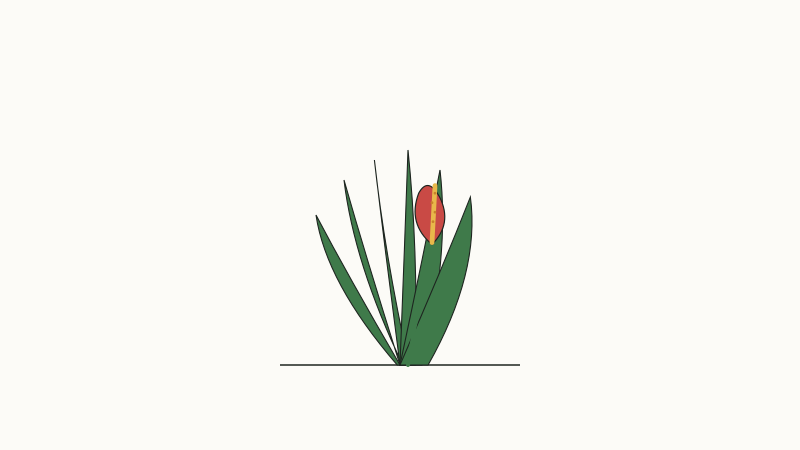
- Corrugated, leathery dark-green blades; narrow and wide forms exist
- Chunkiest possible aroid mix, stem at the surface
- Slow growing; repot in spring only when clearly rootbound
- Toxic to pets if chewed, like every anthurium
Growing requirements
Bright indirect light is right; it tolerates the dimmer end better than most aroids but grows faster and bigger in bright filtered conditions. Keep the mix evenly moist, watering when the surface dries, and never let it waterlog. Humidity is the whole game with this species: it comes from cloud-forest conditions and wants 70 percent or more to hold unblemished leaves, which is why it lives happily in greenhouses, cabinets, and bathrooms and struggles in dry living rooms. Keep temperatures 65 to 85 F, and hold it well above 60 F at night. Feed dilute fertilizer through the growing season and slow everything in winter.
Harvesting and care
A well-grown plant puts out a handful of new leaves a year, each arriving soft and expanding over weeks, so protect the unfurling leaf from knocks and dry air while it hardens. Wipe dust off the ribbed blades gently. The flowers, when they come, are a pale green spathe with a cream-to-pink spadix, a footnote next to leaves that eventually reach 3 to 4 feet. Spider mites are the main pest in dry air. Propagation is by stem cuttings or division of the base, and tissue-cultured wide-form plants are now the common route into ownership. Keep the whole plant away from pets; it is toxic like its relatives.
Common mistakes
- Average room humidity, which crisps the long leaves and invites spider mites
- A dense or oversized pot that keeps the roots wet
- Direct sun, which bleaches and scorches the blades
- Bumping or brushing a soft new leaf while it expands; the damage is permanent
- Expecting fast growth; a few leaves a year is a healthy pace
- Cold below about 60 F, which stalls it and blackens leaf tips
Companion plants
Veitchii is a specimen, not a filler, so the companion logic is humidity, not looks. It shares a greenhouse window or cabinet beautifully with other cloud-forest aroids: clarinervium and crystallinum at its feet complete the anthurium display, and bird's nest or Boston fern handle the same moist air at lower light. Out in a bright room it works as a backdrop for prayer plant and calathea groupings. Anything paired with it inherits the toxic-neighborhood caveat for pet households.
Frequently asked questions
What is the difference between narrow and wide anthurium veitchii?
Two forms circulate: the narrow type has slimmer leaves with many fine ribs and is usually seed grown, while the wide type has broader blades with fewer, deeper ribs and is propagated by tissue culture. Care is the same.
How big does anthurium veitchii get indoors?
Slowly large. Mature leaves run 3 to 4 feet long, and the plant can eventually reach several feet across, so plan a tall pot or basket with room for the leaves to hang.
Is anthurium veitchii toxic to cats and dogs?
Yes. Like all anthuriums it carries calcium oxalate crystals in every part, which burn and swell the mouth if chewed.
Why is my veitchii losing leaves?
Most often a cold draft, a long dry spell, or humidity that dipped too low. Keep it warm, humidity high, and the mix evenly moist, and it holds its leaves for years.